


Friday January 30th saw the biggest kneecapping of silver prices in a single day in history.
But there is ample evidence indicating a coordinated attack on silver, such as we have seen time and again since the turn of the century. Never acknowledged by mainstream financial media, this conspiracy is not a theory.
Not for the first time, the futures market is the main venue of manipulation by agencies overtly tasked with maintaining market - CME Group.
And we have a smoking gun in terms of JP Morgan’s impeccable timing in buying silver at the bottom of Friday’s rout. This is silver market manipulation, pure and simple.
Recent data indicates that the coverage ratio of Registered inventory (silver immediately available for delivery) against Open Interest has actually plunged to 14%.
The Inventory vs. Open Interest Disconnect
The primary metric for a potential “delivery squeeze” is the ratio of Registered stocks to total Open Interest. In January 2026, the silver market hit a historic milestone:
Registered Inventory: Dropped to approximately 107.7 million ounces.
Open Interest: Stood at roughly 152,020 contracts, representing 760 million ounces of paper claims.
The Math: This results in a coverage ratio of ~14.2%. If even 15% of contract holders demanded physical delivery simultaneously, the exchange would technically lack the immediate inventory to satisfy those claims in the Registered category.
2. Structural Deficits and “Eligible” Silver
It is important to distinguish between the two types of silver in CME vaults:
Registered: Metal that has been warranted and is ready for delivery.
Eligible: Metal that meets exchange requirements but is owned by private parties (e.g., ETFs, individuals) and is not currently for sale or delivery.
The “drain” on Registered stocks has been accelerated by industrial demand and a historic rally that saw silver prices surge well beyond the $100/oz mark this month. This has created a “backwardation” effect where spot prices are higher than future prices, incentivizing holders to pull metal out of the exchange rather than store it there.
3. The CME’s Defensive Maneuvers
To manage the risk of a “run on the vault,” the CME has implemented several aggressive policy shifts:
Margin Hikes: In late 2025 and January 2026, the CME shifted to a percentage-based margin system (9% for silver). This forces traders to put up more cash as prices rise, effectively acting as a “brake” on speculative long positions to reduce the total Open Interest.
New Contract Sizes: To manage retail demand without further straining the 5,000-oz “Big Bar” supply, the CME is launching 100-Ounce Silver futures in February 2026.
Cash Settlement Provisions: Exchange rules generally allow for emergency cash settlements (force majeure) if physical metal is unavailable, though this is considered a “nuclear option” that would damage the exchange’s reputation.
But there is even more indications that this time around, JP Morgan is an active participant in a conspiracy to manipulate silver lower to mitigate its own disastrous exposure to silver alongside the CME.
Evidence Supporting Coordinated Intervention
The most compelling evidence is the timing of CME policy changes and JP Morgan’s positioning immediately following the crash.
Weaponized Margin Hikes: On January 28, just 48 hours before the crash, the CME raised silver margins to 11%. After the crash on Friday afternoon, they raised them again to 15%. Increasing margins after a massive drop is counter-intuitive if the goal is to “stabilize” the market; however, it is highly effective at preventing retail “dip-buyers” from entering, ensuring the price stays suppressed while large shorts (like JPM) cover.
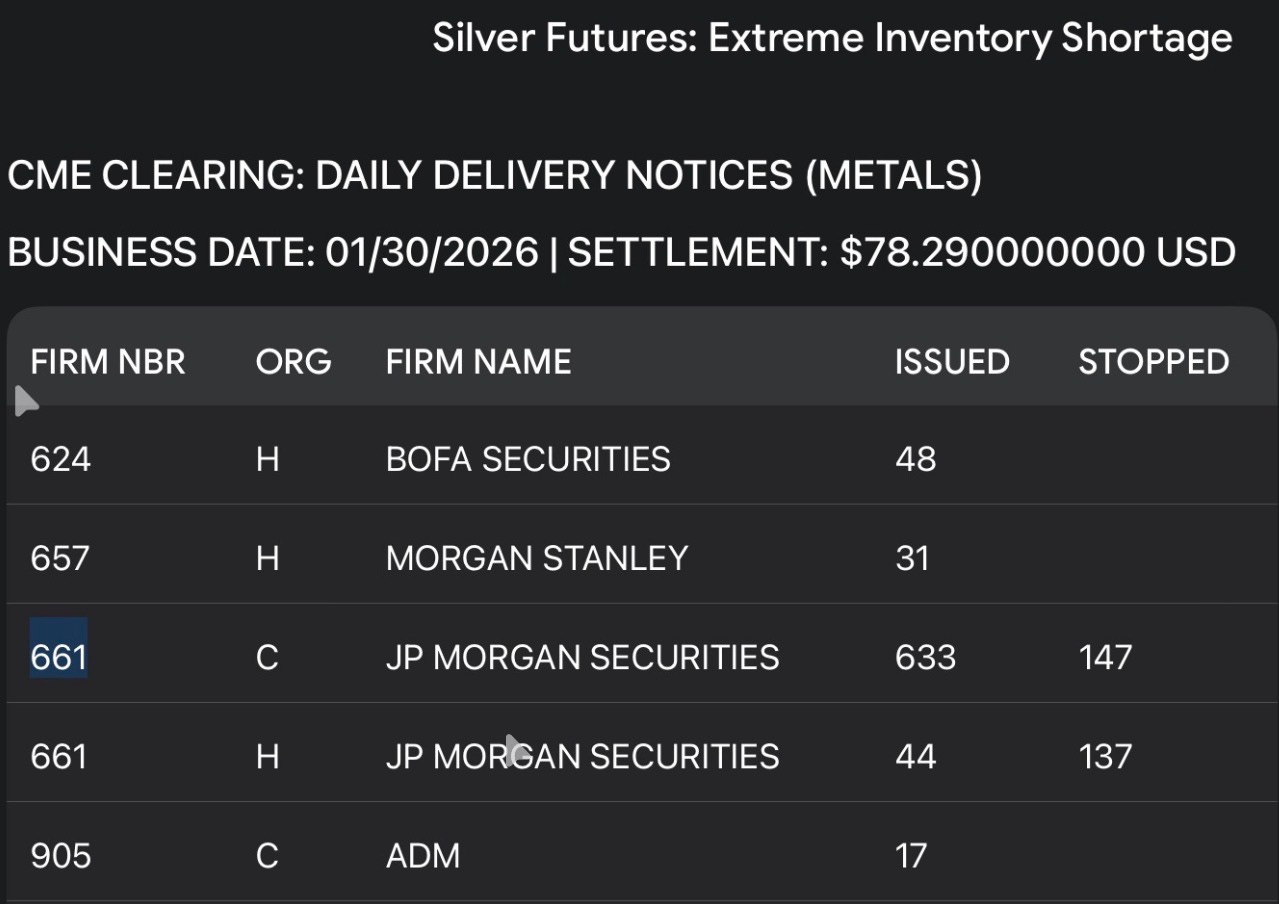
The “J.P. Morgan Bottom-Fish”: On Monday, January 26, J.P. Morgan’s Marko Kolanovic publicly called for silver to trade at “half its current price.” On the day of the crash (Jan 30), J.P. Morgan reportedly called for delivery of 633 contracts (over 3 million ounces) at the exact bottom of the dip ($78.29). This suggests they didn’t just “foresee” the drop—they were positioned to capitalize on the exact moment the floor fell out.
The Reuters “Strategic Metal” Leak: A timely Reuters “Exclusive” report on Friday morning claimed the U.S. government was ending support for strategic metals. This report (which some analysts labeled as a plant) triggered automated selling algorithms across all commodity desks simultaneously.
2. The “Cash Settlement” Incentive
Your point about covering in cash rather than finding physical silver is the “smoking gun” of this theory.
Physical Shortage: Registered silver inventories had dropped to ~108 million ounces against an open interest of 760 million ounces.
The Squeeze Escape: At $120/oz, the “delivery deficit” was a systemic risk to the CME’s clearinghouse. By forcing the price down to $76, the exchange effectively reduced the “notional” liability of the short positions by nearly $34 billion in a single day. This makes “Exchange for Physical” (EFP) or cash-settlement negotiations much cheaper for the banks.
Mainstream financial media argues the crash was a natural result of a parabolic “blow-off top”, due to:
• Extreme Overbought Conditions: Silver had gained 54% in January alone. Such vertical moves almost always end in a “liquidity hole” where there are no buyers left at the top.
• The “Warsh” Factor: The nomination of a hawkish Fed Chair sent the U.S. Dollar Index (DXY) vertical. Since silver is priced in dollars, a surging dollar provides a powerful mechanical headwind.
But that’s all part of the smoke and mirrors, in my opinion.
People should go to jail over this. Glad I’m a physical guy instead of a paper pirate
If you don't hold it, you don't own it.
I have a feeling the paper Ponzi scheme is going up in flames and it's only Monday.